Not affiliated with U.S. Courts
AO 239: Application to Proceed Without Prepaying Fees (Long Form)
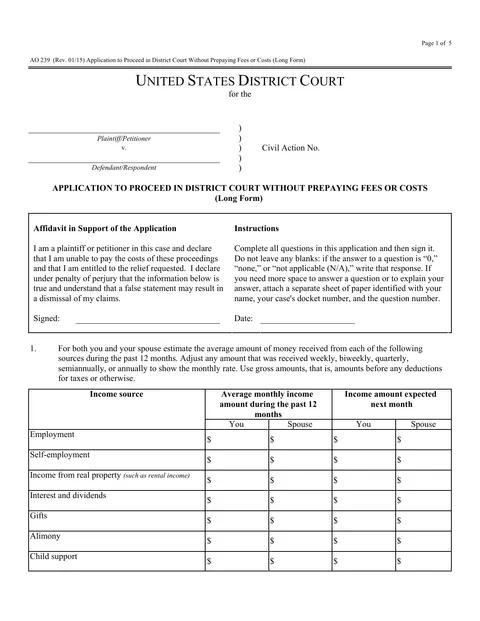
AO 239 is a sworn financial affidavit you file in a U.S. district court to ask permission to bring a civil case without prepaying the filing fee and costs, known as proceeding in forma pauperis.
Administrative Office of the U.S. Courts · Edition shown: Rev. 01/15 · 5 pages
fenfill is a private company. This page is not run by, affiliated with, or endorsed by Administrative Office of the U.S. Courts. You can get the blank form from U.S. Courts directly. You file it with U.S. Courts yourself and pay any fee directly to them. fenfill never sees what you type.
This page is general information, not legal, tax or immigration advice, and not a substitute for advice from a qualified professional.
Who uses AO 239
A plaintiff or petitioner who can't pay the costs of a federal district court case uses AO 239 to ask the court to let them proceed without prepaying fees. You declare under penalty of perjury that you can't pay and that your answers are true; a false statement may result in dismissal of your claims.
The form asks for detailed information about you and your spouse: monthly income over the past 12 months, employment history, cash and bank accounts, assets, money owed to you, dependents and monthly expenses. The judiciary also publishes a shorter version, AO 240. Which one a court expects varies by district, so check the court's own website or ask the clerk's office before you choose.
How and where to send it
File AO 239 with the clerk of the U.S. district court where you are bringing your case. The judiciary says a complaint may be accompanied by an application to proceed in forma pauperis, so it is usually filed together with the complaint. Fill in the district and the parties' names at the top, and the civil action number if one has been assigned.
Each district court sets its own local rules and procedures, including how self-represented people file and what else must be included. Check that court's website before you file. Clerk's office staff can't give legal advice, but many clerk's offices have information packets on filing procedures and can point you to lawyer referral services.
If you are a prisoner, you must attach a statement certified by the appropriate institutional officer showing all receipts, expenditures and balances in your institutional accounts for the last six months, one for each account.
Fees
This application is how you ask not to prepay court fees. The judiciary states the civil filing fee is $350 under 28 U.S.C. § 1914, and its fee schedule adds a $55 administrative fee for filing a civil action, which does not apply to persons granted in forma pauperis status. If the court grants the request, the judiciary says the fee is waived.
The court decides whether to grant the application. Check the court's own site for how it handles fees, especially for prisoner cases.
Deadlines
The judiciary's pages set no separate deadline for AO 239. It normally goes in with your complaint, and the court's local rules govern timing.
Question 9 asks whether you expect major changes to your income, expenses, assets or liabilities in the next 12 months, so answer with that period in mind and describe any expected change on an attached sheet.
Common mistakes
- Leaving questions blank. The instructions say to write "0," "none" or "not applicable (N/A)" instead.
- Reporting take-home pay. Income amounts must be gross, before taxes or other deductions.
- Not converting weekly, biweekly, quarterly or annual amounts to a monthly figure, for both income and expenses.
- Leaving out your spouse's income, accounts or assets. The form asks for both of you.
- Writing the full names of dependents under 18. Use initials only.
- Forgetting to sign and date the declaration, or, for prisoners, to attach a certified account statement for every institutional account.
U.S. Courts's own instructions
About this copy
- Form
- AO 239: Application to Proceed in District Court Without Prepaying Fees or Costs (Long Form)
- Issuer
- Administrative Office of the U.S. Courts
- Edition shown
- Rev. 01/15
- Source
- The blank PDF on www.uscourts.gov
- Last checked
- Against the issuer's site on
fenfill added the fill-in fields; the form itself is unchanged, and the PDF you download has nothing added to it. Check the edition and your answers before you send it.