Not affiliated with Scottish Government
Notice to Leave: private residential tenancy (Scotland)
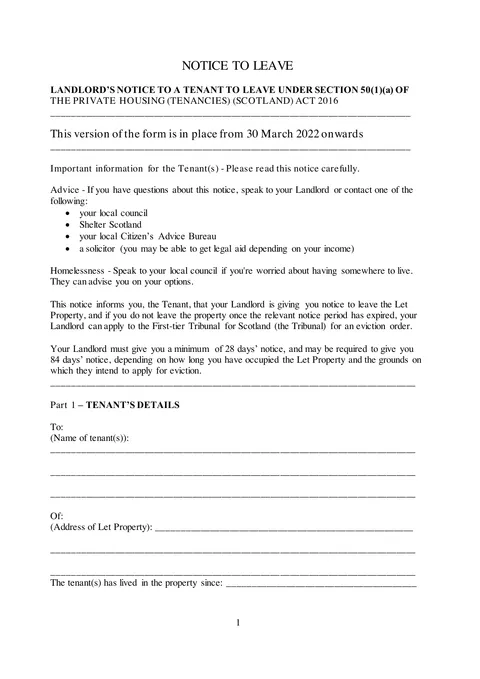
The Notice to Leave is the prescribed notice a landlord in Scotland gives a tenant with a private residential tenancy to start ending the tenancy. It states the eviction ground and the date after which the landlord can apply to the Tribunal.
Scottish Government · Edition shown: From 1 April 2024 · 3 pages
fenfill is a private company. This page is not run by, affiliated with, or endorsed by Scottish Government. You can get the blank form from Scottish Government directly. You give the filled form to your tenant yourself. fenfill never sees what you type.
Scottish Government also has an online route: Create a tenant notice to leave (mygov.scot).
This page is general information, not legal, tax or immigration advice, and not a substitute for advice from a qualified professional.
Who uses Notice to Leave
This notice is for landlords (or their agents) in Scotland whose tenant has a private residential tenancy under the Private Housing (Tenancies) (Scotland) Act 2016. You can only use it when relying on one or more of the 18 eviction grounds in schedule 3 of the Act. Other types of tenancy, and tenancies elsewhere in the UK, follow different processes.
If your tenant sublets, the subtenant needs a separate subtenant notice to leave. Mygov.scot also offers an online service that builds a notice to leave and works out the notice period for you.
If you are a tenant who has received this notice, you do not fill it in. Read it carefully and get advice: the notice itself names your local council, Shelter Scotland, your local Citizens Advice Bureau or a solicitor. Mygov.scot explains eviction from a private residential tenancy, and gov.scot publishes guidance notes for tenants alongside the form.
How and where to send it
As landlord you complete Parts 1 to 4. Name every joint tenant in Part 1, or give each tenant their own copy. Gov.scot says you should also give your tenant the matching guidance notes for tenants. Including copies of your evidence for the eviction ground is advisable.
After signing and dating, give the notice to the tenant by hand, by recorded delivery to the let property, or by email if they previously agreed email is their preferred contact method. A Sheriff Officer can also serve it. Unless a Sheriff Officer delivers it by hand, allow 48 hours for the tenant to receive it and add that to the notice period.
If the tenant does not leave, you apply to the First-tier Tribunal for Scotland (Housing and Property Chamber) for an eviction order, attaching a copy of the notice. You must also tell your local council you plan to evict, using a section 11 notice.
Fees
The notice is served on your tenant, not lodged with gov.scot, and gov.scot lists no fee for it. Mygov.scot states there is no cost to apply to the Tribunal for an eviction order.
Deadlines
The notice period depends on the eviction ground and how long the tenant has lived in the property. It is 28 days if the tenant has been entitled to occupy the property for six months or less, or if you rely only on grounds about the tenant's conduct (such as rent arrears or breach of the tenancy). Otherwise it is 84 days. If you use grounds with different periods, the longer one applies.
The period runs from the date the tenant receives the notice. The date in Part 4 is the earliest date you can apply to the Tribunal, and you must apply within six months of it. After that, you would need to serve a new notice.
Common mistakes
- Giving too little notice. Check the ground and the tenant's length of occupation, and use the longer period if grounds differ.
- Forgetting the 48 hours for delivery when working out the date in Part 4.
- Leaving a joint tenant off Part 1 without giving them their own copy.
- Using a ground that does not apply. If a tenant is misled into leaving, the Tribunal can order you to pay compensation for wrongful termination.
- Serving an outdated version of the notice. Check the current prescribed form on gov.scot before you serve it.
- Waiting more than six months after the date in Part 4 to apply to the Tribunal.
Scottish Government's own instructions
About this copy
- Form
- Notice to Leave: Notice to Leave (Private Residential Tenancy)
- Issuer
- Scottish Government
- Edition shown
- From 1 April 2024
- Source
- The blank PDF on www.gov.scot
- Last checked
- Against the issuer's site on
fenfill added the fill-in fields; the form itself is unchanged, and the PDF you download has nothing added to it. Check the edition and your answers before you send it.
Contains public sector information licensed under the Open Government Licence v3.0.