Not affiliated with HMRC
R38 (Expat): Claim a refund of Income Tax if you're an expat
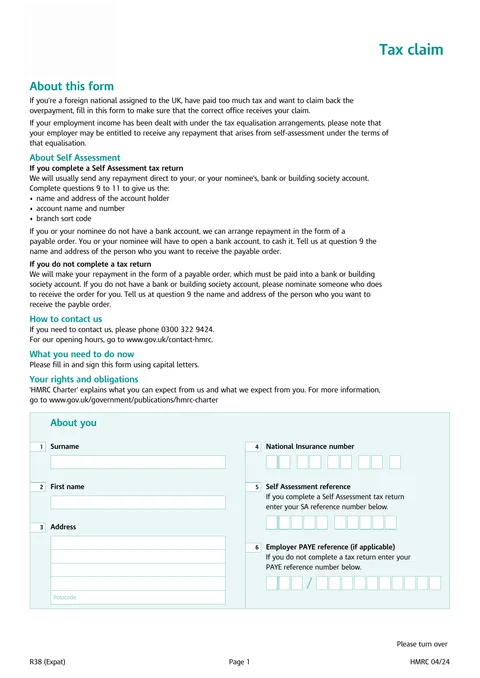
Form R38 (Expat) is a tax claim for foreign nationals assigned to the UK who have paid too much tax and want the overpayment back. It also lets you name someone else, such as an agent, to receive the repayment.
HM Revenue & Customs · Edition shown: HMRC 04/24 · 2 pages
fenfill is a private company. This page is not run by, affiliated with, or endorsed by HM Revenue & Customs. You can get the blank form from HMRC directly. You file it with HMRC yourself and pay any fee directly to them. fenfill never sees what you type.
HMRC also has an online route: Claim online.
This page is general information, not legal, tax or immigration advice, and not a substitute for advice from a qualified professional.
Who uses R38 (Expat)
Use R38 (Expat) if you are a foreign national assigned to the UK, you have paid too much tax and you want to claim the overpayment back. HMRC says using this form makes sure the correct office receives your claim.
If your employment income was dealt with under tax equalisation arrangements, the form warns that your employer may be entitled to any repayment that arises from Self Assessment under the terms of that equalisation.
If you are not an expat, HMRC has other Income Tax refund forms, including the standard R38, depending on why you are claiming.
How and where to send it
You can claim online through HMRC's online form service, or print the paper form, fill it in by hand in capital letters, sign it and post it to HMRC. If you claim online, you get a reference number to track your claim.
The paper form says to send it to: Pay As You Earn & Self Assessment, HM Revenue and Customs, BX9 1AS.
You will need your National Insurance number, your Self Assessment Unique Taxpayer Reference if you file a tax return, your employer's PAYE reference if you have one, the dates of the period you are claiming for, and the name of the person the repayment should go to.
Fees
HMRC does not list any fee for making this claim on its R38 (Expat) page or on the form.
Deadlines
HMRC's R38 (Expat) page and the form do not state a deadline. You give the start and end dates of the period you are claiming for at question 7.
Once you have claimed, you can use HMRC's "Check when you can expect a reply" tool to see current processing times.
Common mistakes
- Leaving out the reference HMRC needs: your Self Assessment reference if you file a tax return, or your employer's PAYE reference if you do not.
- Ticking more than one box at question 8. Choose one of yourself, agent or nominee, and give the agent's reference if you choose an agent.
- Not giving bank details at questions 9 to 11 if you file a tax return. HMRC usually pays the repayment straight into your, or your nominee's, bank or building society account.
- Not naming someone with a bank account if you do not file a tax return. HMRC then repays by payable order, which must be paid into a bank or building society account.
- Forgetting to sign and date the form at question 12, or writing in lower case when the form asks for capital letters.
- Overlooking a tax equalisation agreement with your employer, which may entitle them to the repayment.
HMRC's own instructions
About this copy
- Form
- R38 (Expat): Claim a refund of Income Tax if you're an expat
- Issuer
- HM Revenue & Customs
- Edition shown
- HMRC 04/24
- Source
- The blank PDF on assets.publishing.service.gov.uk
- Last checked
- Against the issuer's site on
fenfill added the fill-in fields; the form itself is unchanged, and the PDF you download has nothing added to it. Check the edition and your answers before you send it.
Contains public sector information licensed under the Open Government Licence v3.0.